

Undergraduate and graduate student presentations from the Department of Physics, 2021 Online University Research Symposium, Illinois State University
-
Multidimensional Diffusion In Crystalline Solids
Hannah Alperstein
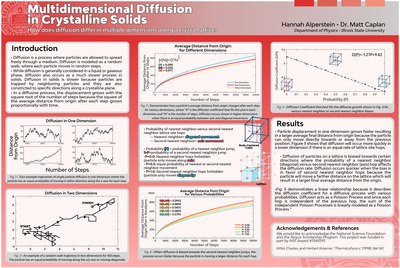
This study explored diffusion rates along a crystal lattice for multiple dimensions. We focused our attention on particle movement through a crystal lattice to determine how the diffusion rate for a crystalline solid depends on the number of spatial dimensions and the probability between diagonal and axis lattice site movement. We used a Monte Carlo approach to simulate the random walk of a particle confined to move between sites along a crystal lattice. The simulation predicted how the diffusion trajectory differed depending on dimensionality and movement probability. From the results obtained, we concluded that the largest diffusive growth for a particle occurred when the particle was confined to one dimension or to movement along the axis of the crystal lattice. During these conditions, the particle traveled the farthest final distance during the random walk.
-
Electron Vortex Beam Collisions Are Sensitive To Projectile Momentum Uncertainty
Alexander Plumadore
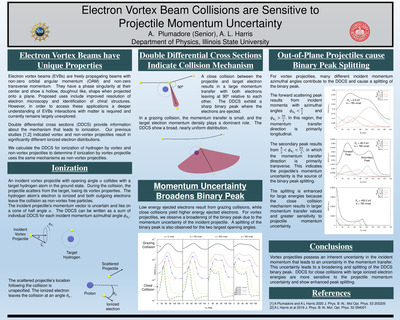
Ionization collisions have important consequences in many physical phenomena, and the mechanism that leads to ionization is not universal. Understanding how and why electrons are removed from atoms and molecules is crucial to forming a complete picture of the physics. Double differential cross sections (DDCS) have been used for decades to examine the physical mechanisms that lead to ionization and two separate pathways have been identified depending on the energy of the ionized electron. At low energies, the DDCS feature a broad distribution as a function of ionization angle, while at high energies, a sharp peak is observed in the distributions. The width of the DDCS peak can be directly traced to the target electron’s quantum mechanical momentum distribution and the results are well-known for plane wave projectiles. However, the recent development of sculpted particle wave packets introduces the opportunity to re-examine the mechanisms that lead to ionization. We present DDCS for (e,2e) ionization of atomic hydrogen for electron vortex projectiles and show that for vortex projectiles making close collisions with the target, the DDCS are sensitive to the projectile momentum uncertainty. Ionization collisions have important consequences in many physical phenomena, and the
mechanism that leads to ionization is not universal. Understanding how and why electrons are
removed from atoms and molecules is crucial to forming a complete picture of the physics.
Double differential cross sections (DDCS) have been used for decades to examine the physical
mechanisms that lead to ionization and two separate pathways have been identified depending on
the energy of the ionized electron. At low energies, the DDCS feature a broad distribution as a
function of ionization angle, while at high energies, a sharp peak is observed in the distributions.
The width of the DDCS peak can be directly traced to the target electron’s quantum mechanical
momentum distribution and the results are well-known for plane wave projectiles. However, the
recent development of sculpted particle wave packets introduces the opportunity to re-examine
the mechanisms that lead to ionization. We present DDCS for (e,2e) ionization of atomic
hydrogen for electron vortex projectiles and show that for vortex projectiles making close
collisions with the target, the DDCS are sensitive to the projectile momentum uncertainty.